The issue of nature in cities is now taking centre stage in conservation policies: urban areas are no longer a blind spot, but a major lever for implementing global biodiversity and health objectives. This momentum was reflected in concrete terms on 10 September 2025, when Paris welcomed a large delegation from the Wildlife Trusts, a member organisation of the IUCN and a leading player in the United Kingdom in the restoration of nature in close proximity to communities.
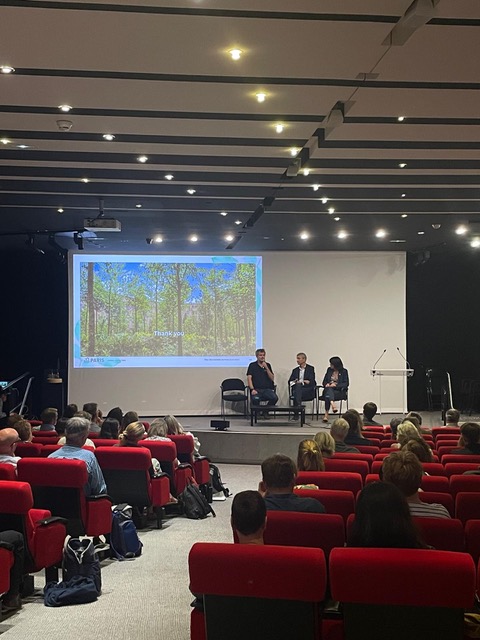
This visit, designed as a collective learning experience (“Seeing is Believing”), brought together nearly 80 representatives from 46 local Wildlife Trusts and the national organisation. The common thread was clear: how to effectively implement Target 12 of the Global Biodiversity Framework, which aims to strengthen green spaces and urban planning for human well-being and biodiversity. Discussions focused on policies for greening Paris, reducing impervious surfaces, ecological continuity and, more broadly, integrating nature into urban planning, with one central question: how to reconcile density, attractiveness, social justice and the restoration of life, while responding to the intensification of climate impacts.
This sequence also confirmed that urban nature policies can only succeed if they are part of a multi-stakeholder governance approach, involving elected officials, technical services, scientists, associations, economic actors and citizens. I recalled the specific role of the IUCN and the growing importance of local authorities’ involvement in this Union, made possible since the World Conservation Congress in Marseille in 2021 and reinforced in Abu Dhabi in 2025 with the adoption of Resolution 8.121 ‘Strengthening the participation of subnational authorities within and through the Union’.
These exchanges showed how cooperation between territories is a decisive accelerator, enabling the sharing of frameworks for action, the comparison of indicators and the creation of momentum beyond national borders.


Comments are closed