In Abu Dhabi, we wanted to make gender equality a fully political issue, in the most operational sense of the term: because effective conservation depends on the quality of governance, access to positions of responsibility, and the ability to include those who deliver solutions on the ground. Too often, equality is treated as a ‘side issue’. However, in a context of intertwined crises, depriving ourselves of half of the talent, knowledge and leadership available is not only unfair: it is ineffective.
The IUCN has a rare institutional advantage in this regard: it is one of the few organisations where both the Presidency and the Director General are held by women. This reality should be highlighted not as an exception, but as a lever for internal transformation. Credible governance on biodiversity and climate change requires credible governance on inclusion, representation and access to positions of responsibility.
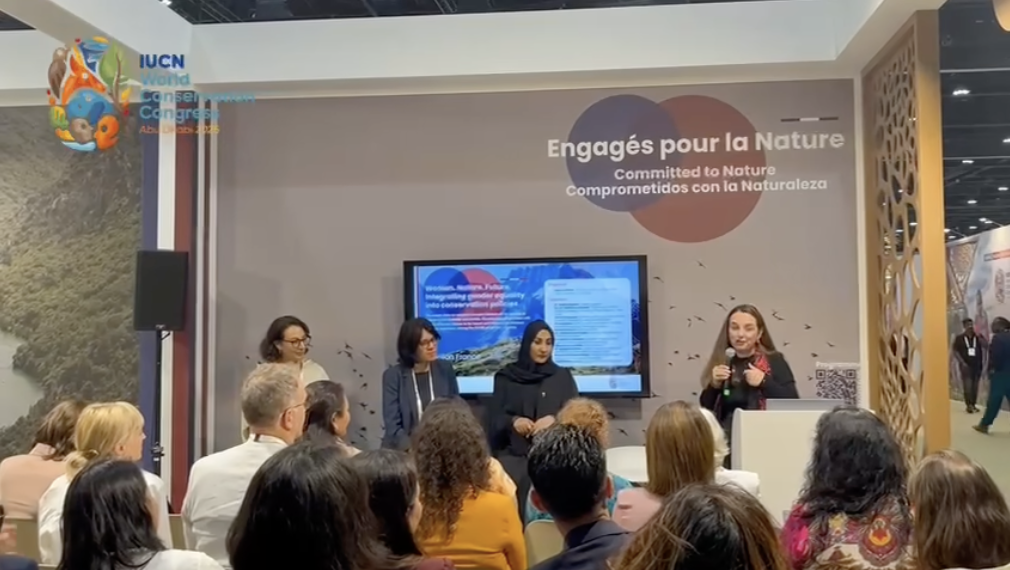
With this in mind, we organised a dedicated event at the French Pavilion entitled ‘Woman. Nature. Future. Integrating gender equality into conservation policies’, designed as a space for strategic and operational dialogue. The starting point was clear: women are key players in environmental governance at the global level, but they still face structural barriers to accessing decision-making processes, financing mechanisms and implementation mechanisms in the field of biodiversity.
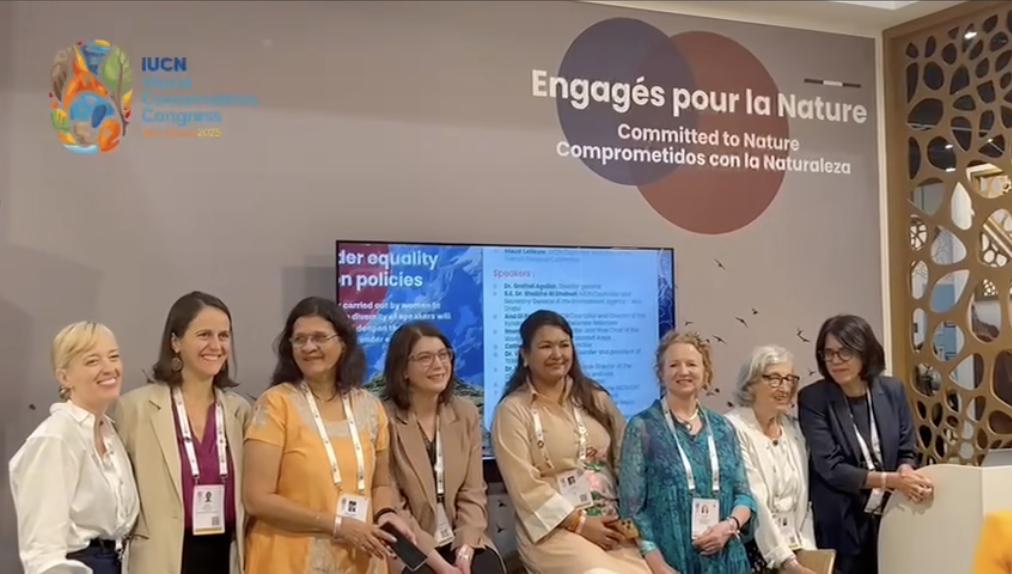
The objective of this session was twofold: to highlight persistent inequalities within conservation — in terms of representation, security, recognition and access to resources — and to identify concrete strategies for removing these barriers within IUCN. We discussed very practical levers: improving conditions for participation in governance spaces, strengthening the role of women in project design, making access to funding more direct and transparent, systematising indicators and disaggregated data, and disseminating tools to enable member organisations to integrate gender equality into their programmes and standards. The ambition, ultimately, is simple: to make equality a factor in conservation performance, rather than an issue dealt with alongside everything else.


Comments are closed